

Exploring the Roots of Traditional Witchcraft: Where Our Practices Really Come From
When someone discovers you practice witchcraft, there's often an assumption that you're following some trendy new spiritual movement that emerged from Instagram or TikTok. The truth? Traditional witchcraft has roots that stretch back thousands of years, weaving through ancient civilizations, medieval grimoires, folk healing traditions, and cultural exchanges that span continents. What we practice today is not a modern invention but a living tradition built on layers of ancestral knowledge, ceremonial magic, and practical folk wisdom.
Let's explore where our practices actually come from, because understanding these roots changes everything about how we approach the craft.
Before Christianity: Magic as Wisdom
The practices we call witchcraft today existed long before the word itself carried any negative weight. In ancient societies, magic was not feared but respected. Practitioners held positions of wisdom and status within their communities, working within polytheistic frameworks where magic complemented religious faith and daily life.
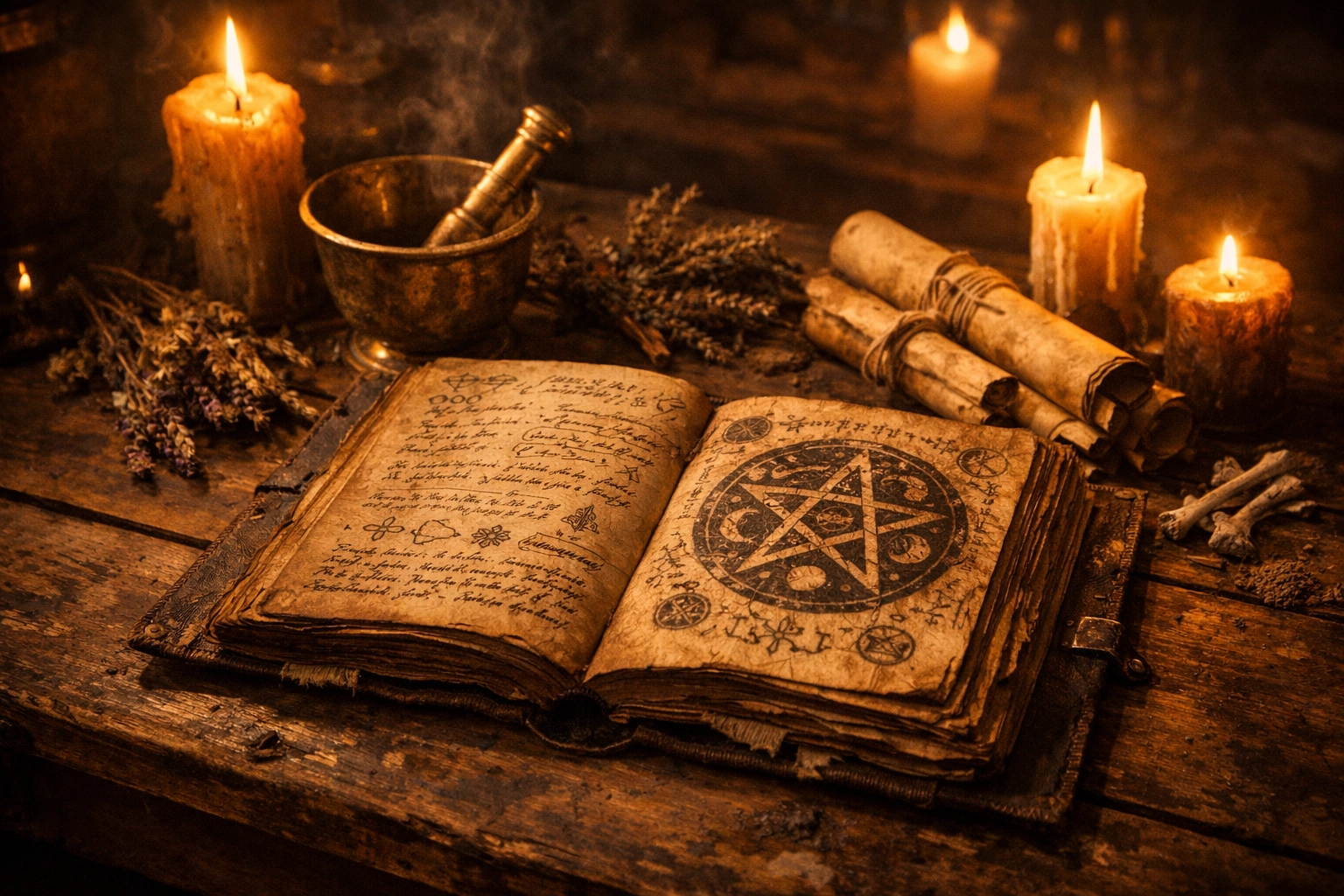
Evidence of magical practices appears in texts as old as Homer's Odyssey (circa 800 BC), where Circe transforms men into swine through her craft. Plutarch's writings around 100 AD reference magical workings as established knowledge. These weren't fringe practices or forbidden arts. They were integral parts of how people understood and interacted with the world around them.
In these ancient contexts, the person who knew how to work with herbs, read omens, perform divination, and direct spiritual forces was valued. They were the ones you turned to when someone fell ill, when you needed protection, or when you sought guidance about major life decisions. Magic was practical, communal, and woven into the fabric of everyday existence.
The Medieval Transformation: From Magic to Witchcraft
The shift from respected magical practice to feared witchcraft happened gradually as Christianity consolidated power across Europe. By the 1300s and 1400s, a crucial transformation occurred. Workers of magic became aligned with satanic elements as the Church sought to suppress any practices that fell outside Christian orthodoxy.
This wasn't just about theology. It was about control. Independent spiritual practitioners, especially women with knowledge of herbalism and healing, represented a threat to institutional religious authority. The word "witch" itself became weaponized, transforming from a descriptor of someone with knowledge into an accusation of heresy.
Yet even as the Church condemned magical practices, ceremonial magic traditions continued to develop, often hidden within scholarly and aristocratic circles. The grimoire tradition emerged during this period, preserving ritual knowledge in encoded texts that blended Jewish mysticism, Greek philosophy, and Arabic magical systems.
The Arabic Connection: Cultural Synthesis in Medieval Spain
One of the most significant yet often overlooked influences on European witchcraft came through the Moorish occupation of medieval Spain. Arabic forms of magical practice and material from Greco-Egyptian papyri entered southern Europe during this period, profoundly shaping what would become traditional European witch-cult beliefs.
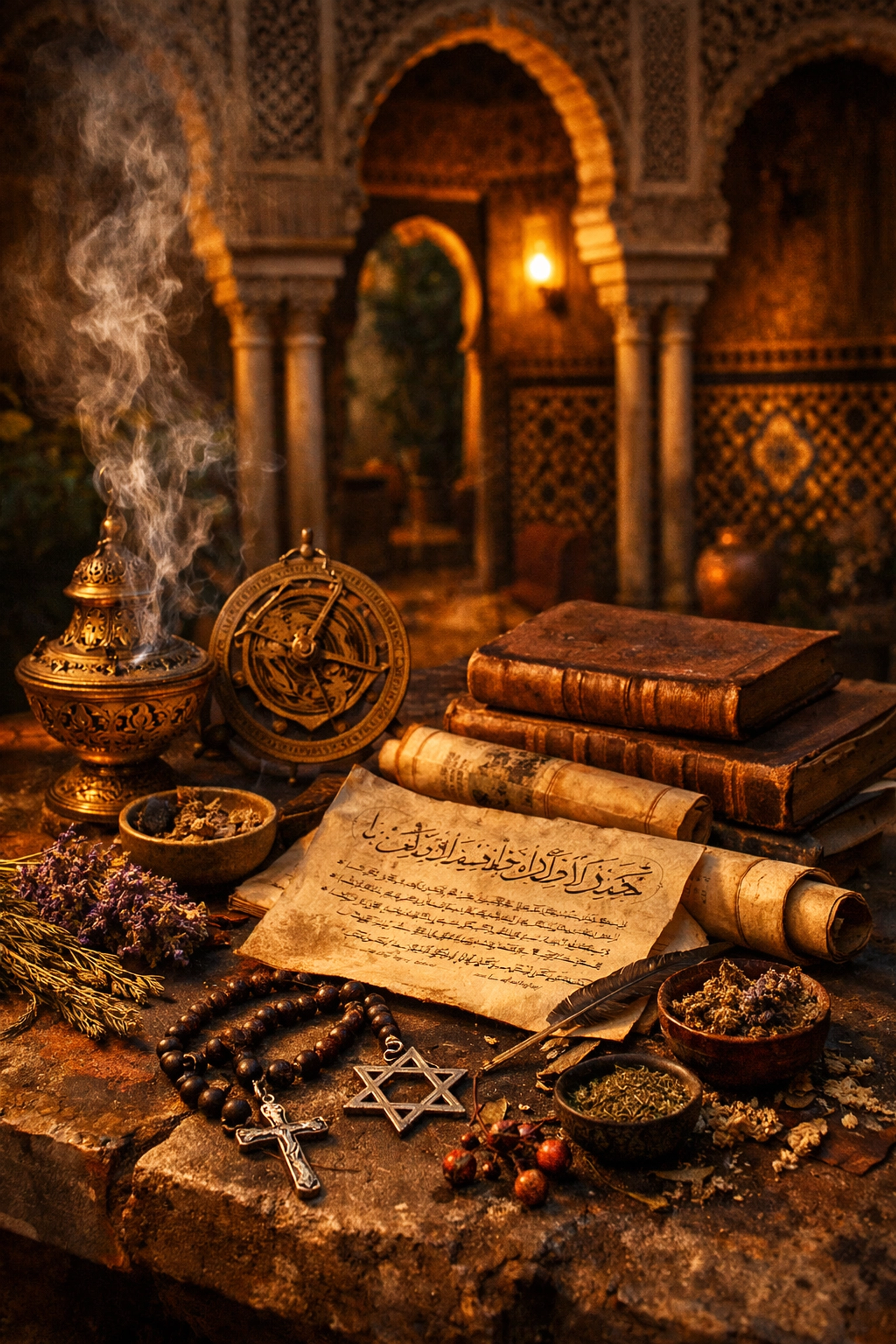
This wasn't cultural appropriation in the modern sense. It was genuine exchange and synthesis happening over centuries. Arabic scholars had preserved and built upon Greek and Egyptian magical knowledge that had been lost to much of Christian Europe. When these texts and practices crossed into Spain and then spread northward, they carried sophisticated systems of astrology, talismanic magic, spirit conjuration, and ritual timing that would become foundational to European ceremonial magic.
The Solomonic tradition, centered on grimoires like the Key of Solomon, exemplifies this synthesis. These texts claim ancient Jewish origins but bear clear marks of medieval Islamic, Christian, and Jewish mystical traditions blending together. By the 1940s, when Gerald Gardner was developing what would influence modern traditional witchcraft lineages, his prototype Book of Shadows drew directly from these Solomonic sources.
Regional Flavors: How Place Shapes Practice
Traditional witchcraft developed distinct characteristics based on geography, culture, and available resources. Understanding these regional variations helps us appreciate that there's no single "correct" way to practice traditional witchcraft.
British Traditional Witchcraft evolved through organized, ritualized magical groups. Historical records suggest existing covens passed down practices through formal initiation. These traditions emphasized ritual structure, seasonal observances, and working with local spirits and land energies specific to the British Isles.
Across the Atlantic, Appalachian folk magic developed its own unique character. Often called "granny witchcraft," this tradition blended Scottish, Irish, English, and German healing practices with African spiritual knowledge and Native American botanical wisdom. The result was a deeply practical form of magic focused on healing, protection, and working with whatever plants and materials were available in the mountain regions.
Colonial American witchcraft took yet another form, incorporating ceremonial magic alongside folk divination methods like the shears-and-sieve technique, palmistry, and card reading. African spiritual traditions merged with Christian elements, creating syncretic practices that honored multiple cultural streams simultaneously.
Living Continuity: Unbroken Lines of Practice
One question that often arises is whether traditional witchcraft represents genuine historical continuity or modern reconstruction. The answer is more complex than either/or.
Documented evidence shows specific practices continuing across centuries. The Canewdon witches of 19th-century Essex, for example, worked with familiar spirits in forms closely resembling those described in East Anglian witch trials two centuries earlier. This suggests genuine transmission of belief and practice through family lines and community teaching.
Traditional initiations followed consistent patterns: midnight ceremonies in remote locations, ritual oaths, transmission of secret knowledge, communal meals, and a chief presiding in symbolic dress. These elements appear repeatedly across different regions and time periods, pointing to shared underlying structures even when specific practices varied.
This is how living traditions actually work. They're not museum pieces frozen in time. They adapt to circumstances while maintaining core principles and practices that get passed from teacher to student, parent to child, elder to initiated practitioner.
The Ceremonial Magic Connection
Traditional witchcraft shares conceptual and practical roots with Freemasonry and ceremonial magic orders, all tracing connections to medieval guild traditions and the symbolic architecture of Solomon's temple. This isn't about one tradition being "borrowed from" another. It's about recognizing that magical practitioners throughout history have drawn from common wells of knowledge.
The grimoires, planetary magic, ritual circle casting, directional correspondences, and invocation practices that appear in traditional witchcraft often mirror ceremonial magic systems because they share historical sources. Understanding this connection enriches our practice rather than diminishing it.
What This Means for Your Practice Today
At Spiral Rain, we approach traditional witchcraft with deep respect for these layered roots. When we create hand-charged ritual items, we're not just making pretty objects. We're participating in a continuum of magical practice that spans millennia. The herbs we work with carry correspondences developed through generations of practitioners noting what worked. The rituals we teach draw from grimoire traditions, folk practices, and ceremonial structures that have proven effective across centuries.
Understanding where our practices come from isn't about achieving some impossible "authenticity" or perfectly recreating the past. It's about recognizing that we stand in a river of knowledge that flows from ancient sources through countless practitioners who refined, tested, and passed down what worked.
Your practice today connects to that river. Whether you're lighting a candle with intention, working with magickal herbs, or creating sacred space in your home, you're participating in something far older and more significant than modern culture often acknowledges.
The roots of traditional witchcraft run deep. They cross cultures, survive persecution, adapt to new lands, and continue growing. By understanding these roots, we practice with greater awareness, respect, and effectiveness. We become not just practitioners but stewards of living traditions that we'll eventually pass forward in our own way.
That's the real magic: being part of something that existed long before us and will continue long after, while making it genuinely our own in this moment.